Hiding from Chinese agents
China has a long and storied relationship with Sacramento. After all, the first all-Chinese rural settlement in the United States was in nearby Locke.
Better known today for “Al the Wop’s” biker bar, Locke was once a river town made up entirely of Chinese Gold Rush-era immigrants. Racism and restriction forced the local “coolies” to move from panning and mining to laying rails and building the levees that still service and save Sacramento.
Sacramento now offers Chinese immigrants new opportunities, freedom and the solitude promised by a secure and increasingly multicultural American society.

Ling Wancheng, a wealthy and politically connected businessman who fled to the U.S., was living in this $2.5 million home in Loomis. China is demanding that the Obama administration return Ling, according to several American officials familiar with the case. Should he seek political asylum, he could become one of the most damaging defectors in the history of the People’s Republic of China. Max Whittaker The New York Times
That promise might be empty, however, for some rich, powerful and possibly dodgy new arrivals from the People’s Republic of China who threaten to hide and speak state secrets to U.S. authorities and journalists. For them, a Sacramento safe haven may not be beyond the increasingly global reach of China’s long arm.
One recent arrival, Ling Wancheng, spent much of last year living up the road in Loomis, sporting an alias, but hiding in plain sight from Chinese agents reported to be operating covertly inside U.S. borders. Who is Ling Wancheng, a man with a decent golf handicap and, according to neighbors, a fine and friendly demeanor? Read more.
Tunnel Vision
Drive around drought-devastated Northern California and you will invariably see cars with “Stop the Tunnels” bumper stickers. “Stop the tunnels” has also become a rallying cry in the United Kingdom, where politicians in London are scrambling to halt the sudden free-flow of immigrants using the Channel Tunnel to pour into England from Calais, France.

Migrants outside the Eurotunnel area, in Calais, northern France, last week. More than 3,000 migrants have tried to storm the area surrounding the Eurotunnel in an attempt to enter Britain.
Two very different challenges related to age-old subterranean engineering solutions meant to transport resources from one place to another. Whether those resources are water, goods or people, tunnels are back in the news. Read more
Greece's Economy Hangs in Balance After 'Greferendum'

Greece needs up to 60 billion euros over the next three years to stabilize its finances, according to the International Monetary Fund. The analysis comes in advance of Sunday's referendum, when Greek citizens will vote on whether to accept the latest terms of the European Union's bailout. We'll get an update on the referendum and the threat the Greek debt crisis poses to the Eurozone and to the U.S. economy.
Greece’s high-stakes gamble
ATHENS, Greece -- The audacity of no hope creates strange and interesting political behaviors and a willingness to take on unimaginable risks. Today, Greece seems to be surrendering to a debt agreement that will stop the drama, but not entirely end the country’s seemingly hopeless economic situation and debtors’ prison. A few days ago, the unanswerable question was if Greece would leave the euro and the European Union.

Pensioners wave ticket numbers as they try to get inside a National Bank of Greece branch in Athens last week. Elderly pensioners were stuck without monthly stipends as Greece deals with its financial crisis. | Simon Dawson Bloomberg News
Political analysts are now asking: What kind of existential game was Greece playing during the six-month standoff with the EU? As of late last week, it was not at all clear that it would end this way. Why? Game theory gives us some insight.
Game theory is a formal study of strategic decision-making. It is how mathematicians, political scientists, defense specialists, economists and others try to predict or create desired outcomes. The recently deceased John Nash was a master game theoretician who, as depicted in the movie “A Beautiful Mind,” showed that “every man for himself” was not the way a group of guys could pick up women in a bar. How was this relevant to Athens’ predicament? Game theory shows a way. Read more
Filling Greece’s ATMs with promises
ATHENS, Greece
Greece faces one of the most difficult decisions in its modern history today as it heads to the ballot box to vote in a referendum few voters truly understand. Regardless of which way the vote goes, the country will be voting on an assuredly painful future.

Prime Minister Alexis Tsipras has called on Greek voters to reject foreign creditors’ demands for more economic austerity in return for rescue loans. | Thanassis Stavrakis The Associated Press
The real unstated question on today’s ballot, however, is: Do the people want to put their future in the hands of their feckless, lying and entirely unreliable radical-left government, led by Prime Minister Alexis Tsipras and his ruthless, heartless henchmen?
Calling him a liar is a serious charge. I watched, however, as he was interviewed critically by Antenna TV and promised the impossible – to reopen the banks within 48 hours of a “no” vote. I am not an economist, but I do hold an ATM card that is being rejected by machines for lack of euro currency. Stocking an ATM requires currency, euro or otherwise. A bankrupt state cannot fill the machines with empty promises. Read more
An Unfamiliar Greece
Spetses, Greece -- This familiar country has suddenly turned unfamiliar. I spent time here in the mid-1970s during college and played semi-pro basketball in Athens. My parents come from Crete and I speak the language.
But I’m feeling lost after an 11th hour political move by radical leftist Prime Minister Alexis Tsipras to call a snap referendum, shut the banks and campaign for rejecting a multinational lending program calling for more painful economic austerity.

Those urging a "no" vote in the upcoming euro referendum rally at Syntagma Square in Athens on Monday. Petros Karadjias - Associated Press
“What are we voting for? I don’t really know,” said housekeeper Maria Moriati, voicing a common sentiment.
The opposition parties say the referendum scheduled for Sunday is simple: Should Greece keep the euro as its currency or not? The answer could ultimately decide whether Greece remains in the European Union.
The country is wracked by uncertainty and fear, but not panic. It has endured the humiliation of economic depression and cycled through governments as a result of financial crises. The bank closures are the final indignity and have raised the level of uncertainty to new levels. Read more
European confederacy slowly dies
Athens, Greece -- Anxiety is a constant presence for people living in Athens as they ride the seven-year see-saw of economic survival and revival.
The signs of economic depression are never far from the surface in a state where the sun shines and the most prominent reminder of democracy and peace sits prominently atop the Acropolis, its marble visage visible from every corner of this city.
A mother who approaches and apologizes profusely while begging for a few cents to feed her family; a proud man who carries a worn briefcase to a job he no longer gets paid to do.

A man works at the Parthenon on Acropolis Hill in Athens, Greece, on Wednesday. | Daniel Ochoa de Olza Associated Press
In response, European institutions have bailed out and chewed out Greece for its profligacy and dysfunction, but in the process, Europe fails to deal with its own survival and identity. As a result, the world is witnessing the slow death of the European project and the ongoing dissolution of the European Union. READ MORE
The perverse act of recruiting kids for war
Kids will be kids. Play, josh, run, swim, maybe a bit of mischief. We marvel at their innocence and sense of freedom; we delight in their unbridled joy. Their smiles and laughter rejuvenate us.
Our society recognizes the need to give children the personal support and security they need to grow into happy and healthy young adults who will eventually be productive and participatory members of society. Which is why it is so difficult to comprehend how any community or its leaders could systematically exploit children, whether via sexual predation, labor exploitation or neglect.

Raqqa Is Being Slaughtered Silently, an anti-Islamic State organization, distributed this photo a child wearing a hat with the Islamic State logo posing with a weapon in Raqqa, Syria. Across the vast region in Syria and Iraq that is part of the Islamic State group’s self-declared caliphate, children are being inculcated with the extremist group’s radical and violent interpretation of Shariah law. | Raqqa Is Being Slaughtered Silently
Most disturbing of all is the current practice of turning boys and girls into front-line fighters and suicide bombers by the Islamic State, al-Qaida, Boko Haram and many other violent extremists. While American kids pack their bags to get ready to hike and fish at woodsy sleep-away camps, a whole passel of tykes in troubled parts of the world are being whisked away for summer terrorist training camps. (Read more)
How sex could save Japan
Survival was the topic of Japan’s Prime Minister Shinzo Abe’s summit last week with President Barack Obama. It was not stated as such, but talks were about long-term economic and military survival for a Japan operating in a world of growing threats and rising powers. But in an odd twist, Japan’s survival has less to do with corporate boardrooms or defense operations centers and more to do with that surreptitious situation room: The bedroom.

President Barack Obama and Japanese Prime Minister Shinzo Abe walk to the Rose Garden of the White House on Tuesday for a joint news conference. For the past decade, Japan has seen its population dropping steadily, and that’s a problem. | Andrew Harnik The Associated Press
Japan is facing one of the greatest post-war crises in history. The Land of the Rising Sun is aging its way to extinction. For the past decade, Japan has seen its population dropping steadily. This is a result not only of a drop in birth rate, but also a lack of fresh blood in the form of immigrants. In 2013, Japan’s government reported a record reduction of 244,000 people – roughly the number of residents in Madison, Wis.
By contrast, the United States is a young and dynamic country. The U.S. population has more than doubled since 1950 and may have recently added another 5 million immigrants to census reports with the stroke of Obama’s executive-order pen. But the riches of youth and vigor are not a given for most post-industrialized nations in the world. In fact, the United States is both an exception and an aberration. Read more here
Fear of doctors, vaccines in California and around the world
Doctors take a pledge to “First, do no harm.” This credo is derived from the Hippocratic oath – a sworn solemn duty doctors make when they embark on their career. The Hippocratic oath is nothing to sneeze at; few other professions require a swearing of allegiance to a millennia-old professional ethical and moral code.
Modern society deeply depends on doctors. Which is why recent international reactions against doctors – from mistrust to outright attack – represent a disturbing trend that can not only lead to an immediate threat to global health workers but also precipitate that all-feared outbreak of an uncontrollable epidemic.

Protesters against legislation requiring California schoolchildren to get vaccinated rally at the Capitol this month. Senate Bill 277, if approved, would require most California parents to vaccinate their children as a condition of enrolling them in private or public schools. Rich Pedroncelli The Associated Press
Fear of doctors and vaccine programs is a worldwide phenomenon, from developing nations to the United States. American trepidation toward state-mandated vaccines in school drew demonstrators last week against California legislation. Protesters came to the capital to fight a change in immunization exemptions. Celebrities added fuel to the fire. Read more...
Foreign graduates of U.S. colleges become agents of change abroad
College acceptance letters landed in mailboxes across the country these last few weeks. Proud families now need to figure out the finances of higher education while managing household teenage exuberance.
Americans entering the Class of 2019 will be joined by a record-breaking number of impressive and competitive foreign students. They bring cultural diversity and will yield future dividends as many foreign students later join elite business and political leadership ranks in their home countries.

This round of nuclear talks with Iran was conducted in American English under the guidance of U.S. Secretary of State John Kerry, right, a Yale graduate, and Iran’s Foreign Minister Mohammad Javad Zarif, second from left, who graduated from San Francisco State and the University of Denver. Jean-Christophe Bott Keystone
Good American higher education for these future foreign leaders is not only good for them, it is great for America.
Money is clearly a part of the immediate benefit: Each class of foreign students brings more than $30 billion in tuition and spending, as reported in a recent Brookings Institution study. Rising tuition costs and increasing numbers of foreigners deliver even more money from abroad, with California being the primary beneficiary of this foreign cash. Read More
Putin Lowers Nuclear Threshold
Documentary filmmakers understand the power of moving images and the candid moment.
HBO’s six-part series “The Jinx” revealed evidence that may seal the conviction of its subject, Robert Durst. More importantly for the world, however, was the new Russian state television documentary about the Crimean crisis, starring a President Vladimir Putin who raised the specter of nuclear war.

People leave after a rally marking the one-year anniversary of the annexation of Ukraine’s Crimea Peninsula, outside the Kremlin, with St. Basil Cathedral in the background, in Moscow on Wednesday. A new Russian state television documentary about the Crimean crisis features President Vladimir Putin raising the specter of using nuclear weapons to defend Russia’s interests, effectively daring the West to risk nuclear war by supporting or intervening in Ukraine. Denis Tyrin The Associated Press
Putin is redefining and reassessing the MAD doctrine in the post-Cold War era. But he is not alone.
Military planners and political leaders around the world are both gaming and training for the tactical use of nuclear weaponry – from field weapons to medium-range missiles – that would cause limited damage but incalculable consequences.
These new weapons and tactics would aim to destroy adversaries’ will to fight or retaliate, but not necessarily their capacity to do so. As a result, Putin is actively changing the unwritten rules of atomic age warfare. READ MORE
Silencing the opposition
Opposition research is an accepted part of democratic battle. You learn as much as you can about your opponent – the inevitable embarrassments of youth, sexual proclivities, financial improprieties or just stuff you can twist or credibly make up to put him or her on the defensive.
Societies with fragile or fake democratic systems have a more efficient way of dealing with political opposition leaders. Lock them up or kill them.
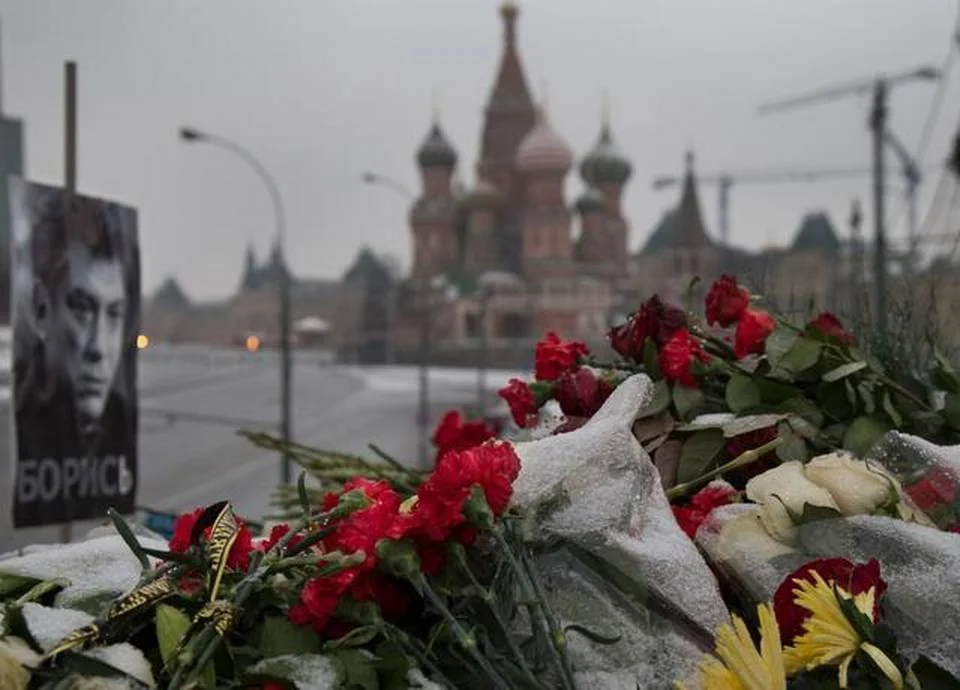
Flowers and a portrait with the word “Fight!” are displayed Thursday in Moscow at the site near the Kremlin where Boris Nemtsov, a charismatic Russian opposition leader and sharp critic of President Vladimir Putin, was gunned down Feb. 27. Alexander Zemlianichenko The Associated Press
Boris Nemtsov is the most recent victim of this highly effective program. He was an active and outspoken critic of Russian President Vladimir Putin and once served as deputy prime minister. There is no evidence – nor will there likely ever be any evidence – to link Russia’s leadership with the assassin who pumped four bullets into Nemtsov’s back in the Kremlin’s shadow. There is plenty of evidence, however, that Putin has enabled and encouraged the corrupt conditions for such cold-blooded criminality and retribution in a paranoid Russia on war footing. (Read more)
Pitching American primacy for 2016
Basketball fan-politicians like President Barack Obama often use sports metaphors when talking politics. As 2014 came to a close and his last electoral cycle passed, he pointed out “my presidency is entering the fourth quarter.”

The fourth quarter of a presidency is the foreign policy quarter. During most presidencies, it is when his leverage over Congress is at its ebb, his political considerations minimized and the time used to crystallize a legacy. For all presidents, this is the time to set the geopolitical gears in motion.
While his team plays the fourth quarter and the clock ticks down, the new 2016 presidential teams are positioning themselves for an electoral shootout. Each team – and there are many – needs to prepare to enter the Oval Office ready not only with a solid and popularly supported domestic agenda, but also be able adjust to what is left behind at the buzzer and to articulate a clear foreign policy plan and vision. Read more
Home sweet palace
Nothing in the political world says “kick me” more loudly than an elected official’s huge house. Or houses.

People walk in the grounds of Ukrainian President Viktor Yanukovych’s countryside residence in Mezhyhirya, Kiev region, Ukraine, in 2014. Nothing in the political world says “kick me” more loudly than an elected official’s huge house. American presidential candidates would do well to heed any warnings that they live lives of excess as this country hurtles toward 2016. Efrem Lukatsky Associated Press file.
Most people consider their own homes to be their figurative castles. But when political leaders’ “castles” are literally palaces, a country’s citizenry often seethes, preparing for that moment when it can finally storm the palace walls. From Russia to Turkey, immodest presidential living with Versailles-level luxury has become au courant and de rigueur. (Read more)