What Does Greece's New Left-Wing Government Mean for Europe's Economy?
Voters in Greece ushered in a left-wing government this weekend that promised to release the country from austerity measures imposed as part of its $270 billion bailout from the European Union. Some experts worry that the election results could spell a Greek exit from the eurozone, which economists warn would be disastrous for Greece, Europe and the global economy. We look at the politics and economy of Greece and the future of the eurozone.

Greece's new Prime Minister Alexis Tsipras. (Milos Bicanski/Getty Images)
Host: Michael Krasny
Guests:
- Barry Eichengreen, professor of economics and political science at UC Berkeley and author of "Hall of Mirrors: The Great Depression, the Great Recession and the Uses -- and Misuses -- of History"
- Markos Kounalakis, visiting fellow at the Hoover Institution and publisher emeritus at Washington Monthly
- Stephany Griffith-Jones, financial markets director at the Initiative for Policy Dialogue at Columbia University
With U.S. riding high, bet on the powerful dollar
Gambling is a daily activity in which we all partake but are likely unaware. Without going to Vegas, America makes long-term bets with our money. U.S. greenbacks in our pockets or banks regularly rise and fall in global value. Lately, it has been a good bet.

Recent international developments have created extremely favorable conditions for the U.S. dollar’s value while many other countries face challenging economic conditions. Multiple factors have a direct effect on the fluctuating value of global currencies, including things like wars, bank crises, political instability, deficits, unemployment, civil unrest and natural disasters.
It is a complex system, but it has simple effects: Americans will find that the dollar’s increased value means a Rome vacation is cheaper, flat screen TVs made in Asia will drop in price, and gas at the pump … well, an oil supply glut and a higher valued dollar could soon lead to a two-buck gallon of gas. (Read more)
Ideas are worth defending against dictators and theocrats
Ideas are dangerous things. Allow them to spread uncontrollably and they can infect the thinking and behavior of a people. Some ideas can lead to revolutionary acts, as with democracy and the concept that power can accrue to the people instead of deities or despots.
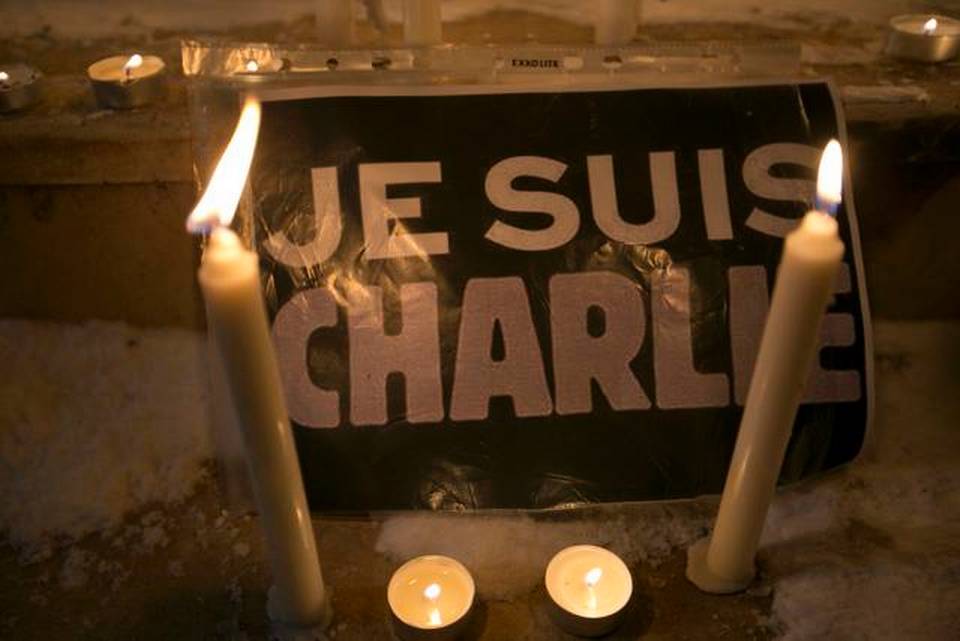
Candles are lit near a sign that read in French “I am Charlie” lights a candle during a demonstration in solidarity with those killed in an attack at the Paris offices of the weekly newspaper Charlie Hebdo in the Kosovo capital Pristina on Wednesday. Visar Kryeziu Associated Press
Ideas allow us to question our beliefs, our leaders and our societies. The viral spread of these ideas has been accelerated over the millennia, making an exponential leap in the early 15th century with the invention of the printing press. What Gutenberg’s machine did to spread ideas challenging religious hierarchy and ideology of the day was revolutionary and catalyzed the Reformation. (Read More)
California ‘White House’ would help Pacific pivot
Symbolism counts for a lot in foreign policy. Adversarial leaders are photographed smiling and shaking hands to show thawing relations. They grimace to show public displeasure. Nonthreatening and soft symbolism makes a point about state relations without allowing for dangerous misinterpretation or miscalculation between nations.

The U.S. should consider operating a western White House out of California on a regularly scheduled basis to signal a shift not only in strategic thinking, writes Markos Kounalakis. The Annenberg Retreat at Sunnylands has already functioned as the successful setting for the 2013 meetings between presidents Barack Obama and China’s Xi Jinping. A seasonally planned Sunnylands stay, combined with a clear “pivot” purpose, would make an even greater statement about America’s strategic outlook. Evan Vucci Associated Press file
Harder, more aggressive symbolic acts get a lot of immediate attention. In the worst case, they can really confuse matters or welcome unintended consequences. To make a tough point, adversarial nations will sail naval subs into other countries’ territorial waters (Russia), fly new stealth fighter jets during a state visit (China), or blow up nuclear weapons as warning shots (North Korea). This harder symbolism shows off increased military capacities, warns real and potential adversaries, and threatens everyone that these countries’ leaders are serious, if not downright unhinged.
Caracas and Cars - Energy & Democracy
Driving up to the gas pump these days is not as frightening as it was just a year ago. Prices are not down to my childhood 49 cents a gallon, but today’s petrol has dropped significantly from the heart-stopping hundred dollar SUV fill-ups.

Members of a pro-government “colectivo,” or “collective,” march in downtown Caracas, Venezuela, this year. President Nicolas Maduro and his supporters say the escalating protests against his socialist government in the oil-rich but economically struggling country are part of an attempted coup. Rodrigo Abd Associated Press file
That is good news for American commuters, with the extra buck or two of savings possibly going toward holiday gift spending. But this good news for U.S. consumers is bad news for countries and governments that rely heavily on high prices for gas exports to pad their leaders’ slush funds or pay their nations’ bills. (Read More)
Crisis over missing students signals Mexico tipping point
Students in California are warming up for further protests against the UC regents plan for statewide tuition fee increases. Peaceful demonstrations are a rite of passage for college kids – an extracurricular activity teaching civil society and civic engagement lessons. But when hard battle lines are drawn and passions get high, the stakes get higher. Protests become exercises in civil disobedience, full of pushing matches or mass arrests.
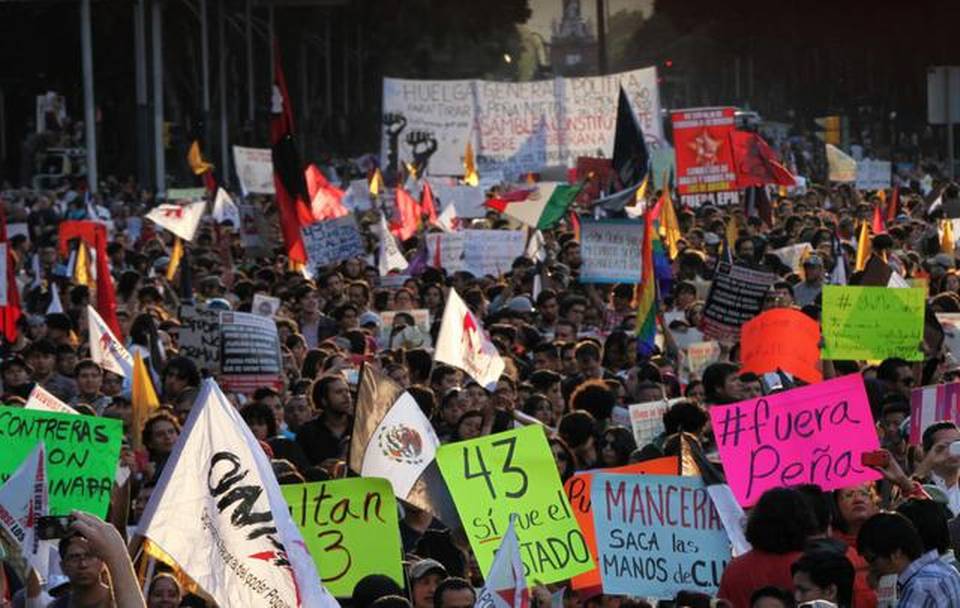
Demonstrators march last Sunday in Mexico City to protest the disappearance of 43 students in the state of Guerrero. Marco Ugarte The Associated Press
They can also get extremely violent. Down the road in Mexico, student protests have a history of turning into blood sport. In 1968, student protests there turned into the Tlatelolco massacre. The official number of students killed ranges between 30 and 300, with still no reliable accounting. The 1968 events remain an open social wound in Mexico. (read more)
Get ready for the 2016 Election
Propositions and congressional races are sucking up all the political oxygen in the run-up to Tuesday’s statewide election. They should. Informing ourselves and getting out the vote is critical for the healthy functioning of our democracy.

Sen. Rand Paul, CAROLYN KASTER/THE ASSOCIATED PRESS
But for an electorate hoping for post-midterm relief from campaign ads and candidate messaging, that reprieve will be short-lived. Soon after the November ballots are tallied, the 2016 presidential campaign will kick in. Hold on for the ride. (read more)
Our attention strayed from missing Nigerian girls for too long
Nigerian military officials now say that more than 200 girls abducted in April by the heavily armed Boko Haram rebels will be returned.
That’s encouraging news because despite the early media attention, high-level appeals, negotiations and tracking, only a handful of have escaped their abductors so far.

Singer Alicia Keys, second from right, joins “Bring Back Our Girls” protesters at the Nigerian consulate in New York on Tuesday, marking the six-month anniversary of the kidnapping of Nigerian schoolgirls by Boko Haram militants. Kathy Willens/ AP
Six months after the hashtag diplomacy campaign #BringBackOurGirls hit its zenith with a White House photo appeal by First Lady Michelle Obama, Twittering was seemingly the only sustained activity highlighting these schoolgirls’ plight. International attention is fickle and solutions never easy. (read more)
U.S. takes significant steps rid world of land mines
Princess Diana’s legacy still inspires debate. The royal cover girl who historically sold greater numbers of magazine issues than any other celebrity was no more or less flawed than most human beings – just a lot more privileged and popular.
One positive legacy continues, however. The United States recently paid tribute to Lady Di’s unwavering and highly visible fight to eradicate anti-personnel land mines.
In a keynote address she delivered to the Mines Advisory Group a couple of months prior to her death, she said, “The mine is a stealthy killer. Long after the conflict is ended, its innocent victims die or are wounded singly, in countries of which we hear little.” (read more)
Greece is a good insurance policy for the West
PYLOS, Greece – Marble statues are nothing new in Greece. Recently uncovered in the northern Greek town of Amphipolis are a couple of elaborately sculpted, fully hair-braided caryatids standing at the entryway to an elaborate Alexander the Great-era tomb.
Farther south, in the current Greek prime minister’s hometown situated on Navarino bay, the most notable monument in the quiet central square is a memorial dedicated to three Western military commanders who fought more recent battles than Alexander’s.
Greek Culture Ministry
Archaeologists this month inspect a female figurine on a wall leading to the main room of an ancient tomb in Amphipolis, northern Greece.
It is a maritime-adorned obelisk dedicated to three admirals who sailed to Greece to take on the Islamic caliphate. A few hundred yards away is where a coalition of Western powers made up of British, French and Russian naval forces entered the bay and destroyed the formidable occupying Ottoman fleet. The year was 1827 and it led to Sultan Mahmud II, self-proclaimed caliph, spiritual leader of all Muslims, declaring an ultimately unsuccessful jihad, or holy war, on European powers.
It is easy to draw parallels between those battles and today’s struggle against the Islamic State. Western success catalyzed Greece’s liberation and the eventual downfall of the Ottoman Empire. (read more)
The risky business of a foreign correspondent
Nightmares of abduction and confinement disrupted my sleep the night before I left for Afghanistan. It was Dec. 1, 1991, and I was working on a freelance piece for The Los Angeles Times Magazine, flying into Kabul from Uzbekistan on a Soviet military transport on my birthday. My best friends were foreign corresponding colleagues and together we made a pact over shots of vodka that if anything happened to us in the field, we would immediately mobilize media and the U.S. government to aid and rescue us. (Read more)
Students and supporters hold a candlelight vigil Wednesday at the University of Central Florida in Orlando, to honor Steven Sotloff, the second American journalist to be beheaded by the Islamic State group in two weeks. Sotloff attended the University of Central Florida between 2002 and 2004.
Time is now for cooler negotiations between Obama and Putin
REYKJAVIK, Iceland – Volcanoes and glaciers, fire and ice, are dominant features of this moonscape-pocked island nation. How fitting that over a generation ago the leaders of the United States and Soviet Union came to talk disarmament in the heat of the Cold War. (read more)
Independence movements in Scotland and California missing the point of strength in unity
LONDON -- Boris Johnson is the colorful mayor of London who wanted to be “World King” when he grew up. Boris, as locals refer to him, promotes a more inclusive London and open policies that would throw open the doors to foreigners, saying, “I’m one of the politicians willing to stand up for immigration.” (read more)

Jill Lawless/ The Associated Press
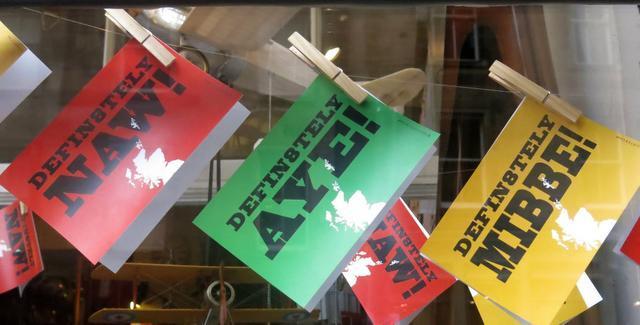
Cards hang in a shop in Edinburgh, Scotland, saying “No,” “Yes” and “Maybe” for the upcoming vote on Scotland’s independence from the United Kingdom. Scottish voters will decide whether their country should become independent, breaking up Great Britain as it has existed for 300 years.
Sanction may backfire in Russian rocket sales to U.S. space program
Sophisticated Russian rocket technology took down Malaysia Airlines Flight 17 over Ukraine. It now has the potential to take down America’s Air Force and NASA rocket programs. (read more)

John Raoux/Associated Press file
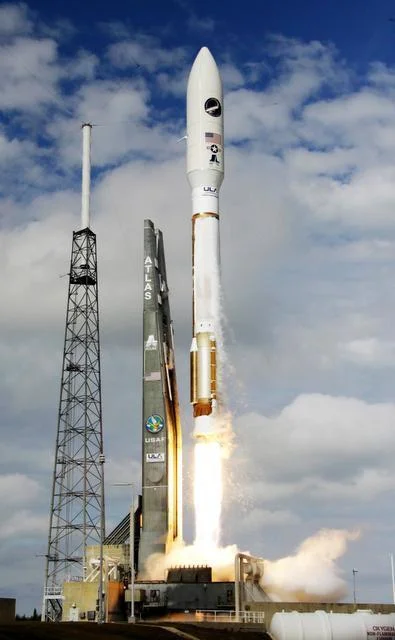
A United Launch Alliance Atlas V rocket, carrying an X-37B experimental robotic space plane, lifts off in December 2012. If the Russians make good on their threat to withhold the RD-180 engine used in the rockets, it could have up to a $5 billion impact on the U.S. space program.
Exporting guns and gangs to Central America, and importing victims
The balance of trade in misery is hard to measure. The United States is importing inordinate suffering with the increasing numbers of victims fleeing Central American violence. More than 52,000 unaccompanied minors have recently entered the U.S. and sparked the latest immigration crisis.

People are rafted across the Suchiate River to the shore at Ciudad Hidalgo, Mexico, from Tecun Uman, Guatemala, earlier this month.
On the export side, guns and gangs are mainly U.S. products that infect Central American societies and are to blame for much of the extreme violence and corruption down south. The exported means of violence, combined with hopeless economies, drive kids into the arms of dangerous mercenary escort “coyotes” and their promise to lead them north to safety and opportunity. (read more)